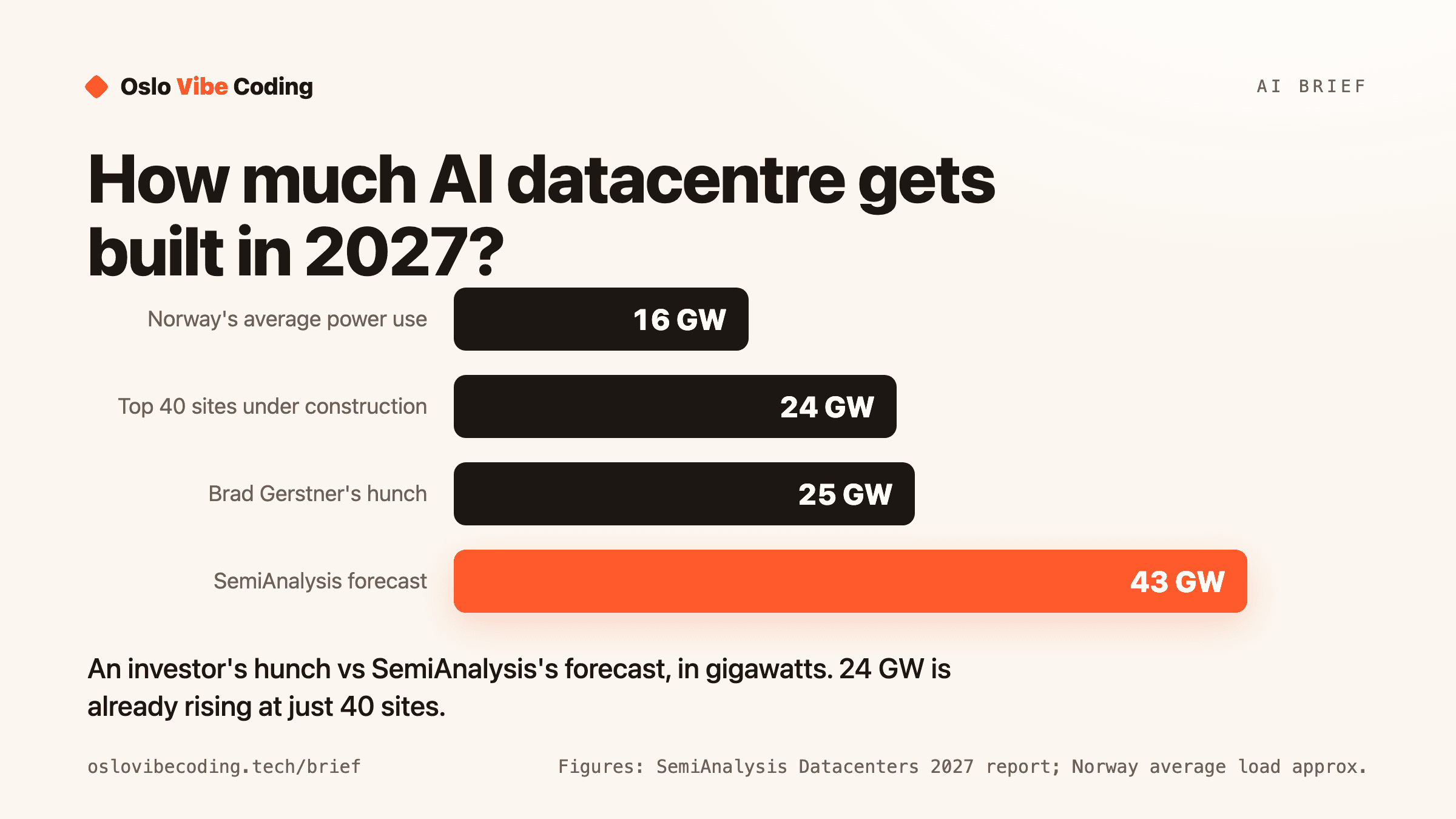
In October 2026 Brad Gerstner of Altimeter Capital showed SemiAnalysis's forecast of about 43 gigawatts of new AI datacentre capacity in 2027 on the All-In podcast and again in a BG2 interview with Nvidia's Jensen Huang, called it too aggressive, and said he expected about 25 gigawatts, based on what he called a hunch. SemiAnalysis replied on 19 October with the report 'Datacenters 2027: the year of acceleration' and on 20 October with a podcast episode titled 'Brad Gerstner Cut Our 2027 Forecast in Half. We Raised It.' Its evidence: more than 24 gigawatts already in an advanced stage of construction at just its top 40 campuses, most of it due in 2027; record quarterly construction starts by US hyperscalers; and roughly a trillion dollars of binding, non-cancellable datacentre leases signed in 2026 so far, which developers use to raise the debt that pays for the buildings. SemiAnalysis says power is 'broadly solved' through on-site generation and that modular, prefabricated designs have cut build times to under 10 months at some sites. Both numbers are forecasts; SemiAnalysis sells the datacentre model it is quoting, and its full oversupply analysis is behind a paywall. For scale, Norway uses about 16 gigawatts on average.
What happened
Brad Gerstner runs Altimeter Capital, an investment firm with large bets on AI companies, and is a regular on the All-In podcast, one of the most listened-to shows in Silicon Valley. Earlier this month he put a chart from SemiAnalysis (the chip and datacentre research firm this channel follows) on screen. It showed SemiAnalysis's forecast that about 43 gigawatts of new AI datacentre capacity will be switched on worldwide in 2027. Gerstner called it 'too aggressive' and said he thought about 25 gigawatts would get built. He repeated the point in his BG2 interview with Jensen Huang, the head of Nvidia. Asked where his number came from, he called it a hunch.
A gigawatt here means the electricity a datacentre is built to draw. It is the standard way the industry counts AI capacity, because the chips are useless without the power to run them. Norway's whole electricity use averages about 16 gigawatts. So the argument is over whether the world adds roughly one and a half Norways of AI datacentres next year, or close to three.
SemiAnalysis did not take it quietly. On 19 October it published 'Datacenters 2027: the year of acceleration', opening with 'let's not operate on hunches'. The next day it released a podcast episode with the blunt title 'Brad Gerstner Cut Our 2027 Forecast in Half. We Raised It.' Its analysts say the curve they have been tracking since March 2024 has barely moved across every revision of their model.
The facts
The 40 sites. SemiAnalysis's lead exhibit is a page of aerial photos of the 40 biggest AI campuses it tracks. Together they hold more than 24 gigawatts in an advanced stage of construction, most of it due for delivery in 2027, and most of them more than halfway done, with cooling and electrical equipment already installed outside. That alone roughly equals Gerstner's whole-year number, and SemiAnalysis says it is a small share of the several hundred sites it tracks in advanced construction.
The construction starts. The firm counts how many megawatts of their own datacentres the big US cloud companies (Amazon, Microsoft, Google, Meta) start building each quarter. It says that number has never been higher and is 'going parabolic', driven mainly by two of them, which it names only to paying clients.
The leases. This is the strongest leading indicator, because of how these buildings are paid for. A developer typically spends only 5 to 10% of the money on a project before it has a tenant. Then it signs a 'pre-lease', usually 15 to 20 years long, worth $30 to $50 billion over its life for each gigawatt, and borrows against it to build the rest. SemiAnalysis counts roughly a trillion dollars of binding, non-cancellable leases signed so far in 2026 (the report puts it as both 'slightly under' and 'over' a trillion in different places), and says most of the matching debt has already been raised. Oracle started the era of giant leases with about 4.5 gigawatts across three sites between August and October 2025. Meta, Amazon, Microsoft, Google, Nvidia, AMD, Anthropic and OpenAI are now all signing gigawatt-scale deals.
Why 2026 looked slower. SemiAnalysis explains the flatter growth this year with Microsoft, which drove most of the leasing market in 2023 and 2024 and then paused in late 2024. Buildings leased in a quiet year open in a quiet year. The leasing boom since mid 2025 is what opens in 2027.
How you build that much that fast. The report's answer is that the industry has changed how it builds. Google has replaced much of the outdoor cabling that had to be assembled on site with prefabricated electrical modules. Meta has built datacentres in tents. Amazon has a simplified shell design and prefabricated data halls, with construction now under 10 months, and SemiAnalysis says modular methods can cut the specialist electrical and plumbing labour by up to 63%. A Singapore developer called DayOne has leased about 3 gigawatts with build times of about 9 months, against more than 18 for traditional builders.
Power and geography. On electricity, SemiAnalysis's view, labelled here as its opinion, is that the problem 'has broadly been solved', because AI companies now build their own power plants next to the datacentre rather than waiting five to ten years for a grid connection, using everything from fuel cells to truck engines to refurbished turbines. (We covered Meta's gas plants on 18 October.) It also expects the build outside the US to accelerate sharply in 2027, partly to escape American labour, power and permit limits.
What it does not hide. SemiAnalysis lists the problems itself: workers not showing up, delayed equipment, fundraising trouble. It says its model trims developer timelines that look too optimistic, and points to having flagged the delay at an Oracle site in New Mexico in April. It also writes that 50 gigawatts in one year would be roughly the entire world's cumulative datacentre stock up to 2024, built in twelve months. The section on whether all this ends in an oversupply is for paying subscribers only.
24 gigawatts is already rising at just 40 sites. The investor's estimate for the whole year was 25.
The everyday version
Imagine two people arguing about how many new flats Oslo will finish next year. One says it feels like the city cannot possibly build that many: there are not enough builders, the power company is slow, interest rates are high. The other walks round town, counts the buildings that already have walls and a roof, and then asks the banks how many signed rental contracts they have lent money against. Both could be wrong. But only one of them has looked at the cranes.
That is the shape of this argument. Gerstner's case rests on real constraints that everyone in the industry talks about. SemiAnalysis's case rests on counting what is already physically standing and what is already contractually paid for, which is much harder to wave away for a single year ahead. It says less about 2028 and beyond.
Is this actually new?
Arguments about whether a building boom is real are as old as building booms. The closest precedent is the fibre-optic cable boom around 2000, when telecom companies laid far more cable than the internet of the day could use, and much of it sat dark for years after the money ran out. The bear case for AI datacentres is the same story with chips.
What is different this time is where the evidence sits. In 2000 the cable was mostly financed on hopes of future traffic. These datacentres are, by SemiAnalysis's count, mostly financed against 15 to 20 year leases signed by some of the richest companies in the world, and the firm says the binding part is already signed. That does not prove the demand will be there in 2030. It does make the 2027 number a question of construction, not of belief.
Two honest caveats. SemiAnalysis sells the Datacenter Industry Model it is quoting, so a bigger forecast is also good marketing; its track record on calling delays is a point in its favour. And Gerstner is an investor with his own reasons to sound measured. Neither number is a measurement yet. The scoreboard is the end of 2027.
What it means
If SemiAnalysis is right, 2027 brings a flood of new computing. Its own conclusion is that this means cheaper and smarter AI, faster progress between model generations, and more revenue for the labs that sell tokens (the units AI usage is billed in). It also means 'unthinkable' spending, and SemiAnalysis expects interest rates to be pushed up by the sheer amount of borrowing needed. Its paid section hints at the next bottleneck: memory and logic chips, rather than buildings and power, may be the tightest constraint in 2027 and 2028.
For anyone in Oslo using these tools, the practical reading is simple. The supply of AI computing next year looks set by concrete already poured and contracts already signed, not by podcast sentiment. That points to AI getting cheaper per task, not dearer. For Norway, with its cheap clean power, the shift of building outside the US is worth watching: the world is about to need several more Norways of electricity for AI, and the places that can supply it quickly will be asked.
The 2027 number is a question of construction, not of belief. The scoreboard is the end of next year.
Curious about AI? Come build with us.
Oslo Vibe Coding runs free, beginner-friendly drop-ins where we build real things with AI. No one codes alone.