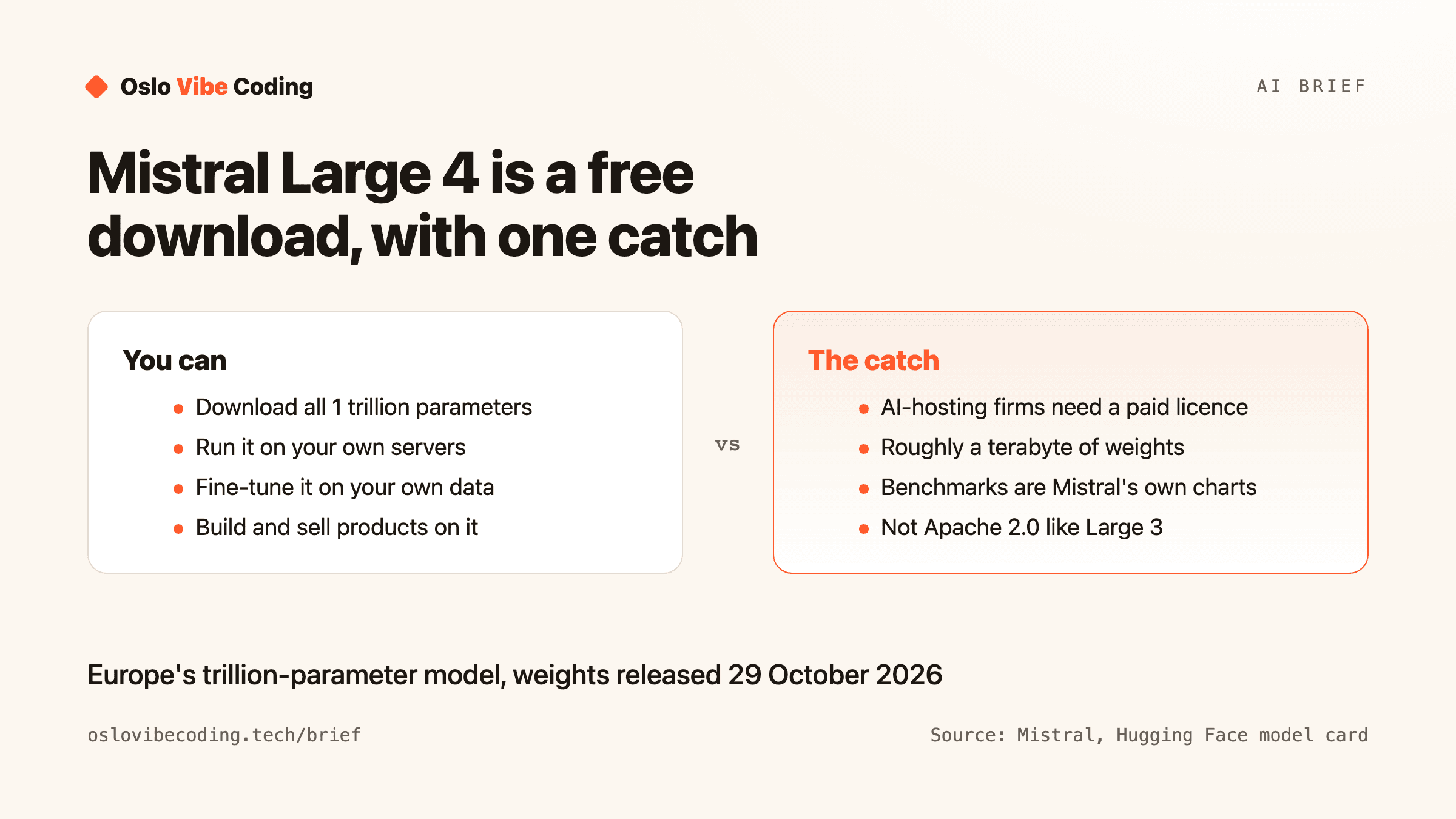
On 29 October 2026 Mistral AI released the weights of Mistral Large 4 ('Le Chonk') on Hugging Face, meeting the end-of-October promise it made with the 6 October public preview. The model has about 1 trillion parameters, 49 billion of them active per token (52 billion including embedding and output layers), a 1 million token context window and support for more than 160 languages, and was trained from scratch on 3,800 Nvidia Grace Blackwell chips in Mistral's own European datacentres. After three more weeks of reinforcement learning, Mistral reports a 48% score on the Artificial Analysis Coding Agent Index (level with China's GLM-5.3 while using 47% fewer tokens), 41% on Terminal-Bench 4.0, 19.7% on Cognition's private FrontierCode 2.0, and 51% on the Artificial Analysis Cyber Index, with Anthropic's Claude Opus 5.5 the only model preferred over it in Surge's blind coding comparison. API prices fell to $0.70 per million input tokens and $2.10 per million output tokens, about half the preview price. The licence is a modified MIT licence: free to use, modify, fine-tune and commercialise, except that companies running a model-as-a-service business need a separate commercial licence. Mistral's earlier Large 3 was Apache 2.0. The benchmark figures are from Mistral's announcement; a technical report is promised.
What happened
On 6 October Mistral released a paid preview of Mistral Large 4, nicknamed 'Le Chonk', and promised the weights (the full trained model, which anyone can download and run on their own machines) by the end of the month. We covered the preview the next day and said the download was the thing to watch. On Thursday 29 October the weights went up on Hugging Face, the main public library for AI models. The announcement reached the top of Hacker News, the tech community's news board, with more than 1,400 points.
It is not quite the model from three weeks ago. Mistral says it spent those weeks on more reinforcement learning (training where the model tries tasks and is rewarded for good results), mainly on coding and defensive cybersecurity, and that 'gains continue to accelerate, with no signs of saturation'. It also cut the price of using it through its own service roughly in half.
The facts
The model. About 1 trillion parameters (the adjustable numbers a model learns in training), built as a mixture-of-experts: only 49 billion of them work on any single word, which makes it far cheaper to run than its size suggests. The model card adds that the figure is 52 billion if you count the input and output layers, which is where the 'A52B' in its file name comes from. It reads text and images, holds up to 1 million tokens (roughly 750,000 words) in view at once, and is fluent in more than 160 languages, including every official EU language. Mistral says it trained it from scratch on 3,800 Nvidia Grace Blackwell chips in its own European datacentres.
Coding, by Mistral's numbers. On the Artificial Analysis Coding Agent Index (an independent test suite) it scores 48%, level with GLM-5.3 from China's Z.ai, the leading open model, while using 47% fewer tokens per task. On Terminal-Bench 4.0, which tests agents working in a command line, it rose 13 points to 41% since the preview, the best among open models. On Cognition's private FrontierCode 2.0, which asks whether a project maintainer would actually merge the change, it leads with 19.7%. In Surge's blind side-by-side test of code answers, graders preferred it over GLM-5.3, Kimi K3 and DeepSeek V4.1 Flash; only Anthropic's Claude Opus 5.5 beat it. These are all charts in Mistral's own announcement; the full technical report is 'coming soon'.
Cybersecurity. Mistral pitches it hard at defenders: 51% on the Artificial Analysis Cyber Index (find a vulnerability, reproduce it, patch it without breaking anything), quotes from Booz Allen, Cisco, Cloudflare, CrowdStrike and ENISA (the EU's cybersecurity agency), and a 96.6% refusal rate on malicious hacking requests. Mistral is also unusually candid: after watching live traffic since the preview, it writes that it sees 'a potential for uplift to conduct real attacks' and is tightening its guardrails. A specialised variant for penetration testing goes only to vetted partners such as Orange Cyberdefense, under contract.
Price. Through Mistral's API it now costs $0.70 per million input tokens and $2.10 per million output tokens, against $1.36 and $4.18 for the preview. It is also on OpenRouter, Microsoft's Foundry and Nvidia's hosted endpoints.
The catch. The licence is called the Mistral Ecosystem Open-Weight License, a modified MIT licence. You may use, modify, fine-tune and sell products built on the model for free, with one condition: a company that runs a model-as-a-service business, selling access to AI models the way OpenRouter or a cloud provider does, needs a separate commercial licence from Mistral. That is a step back from Mistral Large 3 last December, which used Apache 2.0 (one of the most permissive software licences, with no such condition). On Hacker News the top comments made exactly this point: by the strict definition used by the Open Source Initiative, this is 'weights available', not open source.
The hardware. A trillion parameters is roughly a terabyte of data at standard precision. Mistral also publishes a compressed NVFP4 version that roughly halves that. One Hacker News commenter with four of Nvidia's H200 chips, about 560 GB of memory, said they would still need to squeeze the model further to run it. This is a model for companies and governments with serious servers, not for a laptop.
Free to download, use, fine-tune and sell products on. Not free to resell as a hosted AI service.
The everyday version
Think of a famous restaurant. Until now, most of the best AI has worked like eating there: you get the dish, you pay per plate, and the recipe stays in the kitchen. An open-weight release is the chef handing you the full recipe and letting you cook it at home, change it, and serve it in your own canteen. Mistral's catch is that you may not open a rival restaurant whose business is serving that exact dish to the public without paying the chef.
For most companies that is no catch at all. For the cloud and hosting businesses that made money serving earlier open models, it is the whole point.
Is this actually new?
Releasing very large open models is no longer new; Chinese labs have done most of it. DeepSeek, Moonshot's Kimi K3 (2.8 trillion parameters) and Z.ai's GLM-5.3 are all free downloads, and in our brief on who makes the world's open models we noted that Europe's share of downloads is only about 8%. Licences with a 'big commercial users must ask' clause are not new either: Meta's Llama licences required a separate deal for services with more than 700 million monthly users.
What is new is the combination. This is the first open-weight model of this size trained in Europe on European infrastructure, by Mistral's own account the best open model for coding, and released by a company that can be held to European law. For banks, hospitals and governments that are told not to use Chinese models and do not want to send data to American clouds, it is the first top-tier option that ticks every box. Quotes in the announcement from La Banque Postale, Crédit Agricole, ABN AMRO, Belfius and ESA say as much.
The measured caution: open weights cannot be recalled. Once a trillion-parameter model with strong hacking skills is downloadable, its guardrails can be trained away by anyone with enough hardware, which is presumably why the specialised pen-testing version stays behind a contract. Mistral's own sentence about 'potential for uplift' is the most honest line in the release.
What it means
For builders in Oslo, the immediate change is price and choice. A European model that Mistral says is close to the best closed models on coding now costs $2.10 per million output tokens through its API, and can be run entirely in-house if your data must never leave your servers. Norway is not in the EU, but the same arguments about data and control apply to Norwegian public bodies and regulated companies, and Mistral's charts put it ahead of every other open model a cautious procurement team is likely to approve.
The honest caveats are the usual ones for launch day. The benchmark numbers come from Mistral's own announcement, the technical report is not out, and on Hacker News the praise was loud enough that one sceptic called it 'a huge tell' and said the model is still not competitive with the best closed coding tools. Independent tests over the next weeks will settle that. What is already settled is that Mistral did what it said it would, on time.
Europe now has a top-tier model it can run on its own machines. Whether it is as good as Mistral's charts say is the next question.
Curious about AI? Come build with us.
Oslo Vibe Coding runs free, beginner-friendly drop-ins where we build real things with AI. No one codes alone.