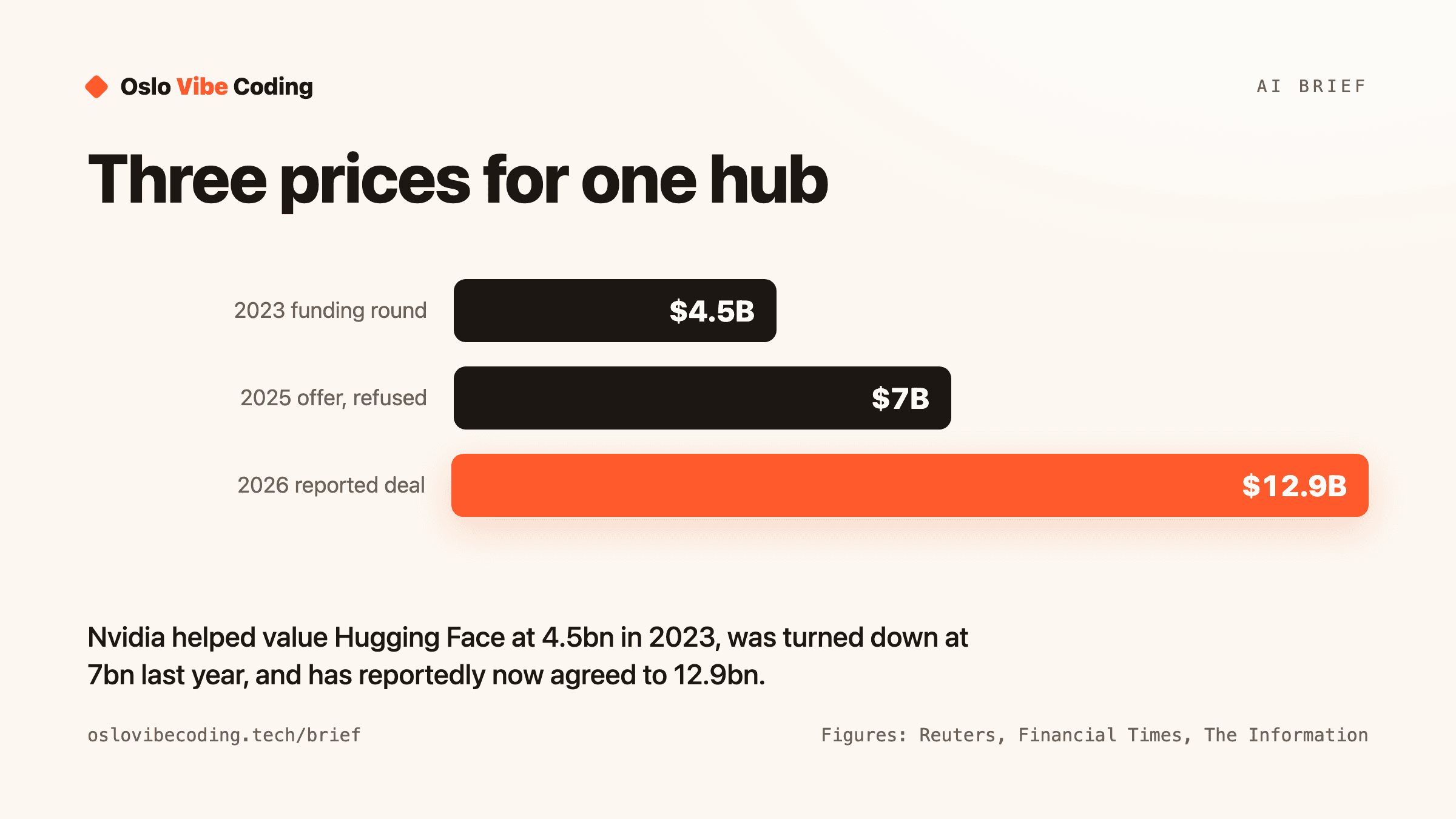
The Information reported on 26 August that Nvidia has agreed to buy Hugging Face for 12.9 billion dollars. Business Insider, which broke the story of takeover interest days earlier, reported the same night that no agreement had been signed and the talks could still collapse. Neither company has commented, which for Nvidia is unusual. The logic is straightforward: every one of Nvidia's largest customers is now building its own chip, and open models running on Nvidia hardware are the counterweight. What is different from the rest of Nvidia's year is the structure. Its three previous deals were licence-and-hire arrangements that left the target formally independent. This one is a plain purchase of the neutral commons where AMD, Google and Chinese labs also publish.
What was reported
On the night of Wednesday 26 August, The Information reported that Nvidia has agreed to buy Hugging Face for 12.9 billion dollars, citing one person with knowledge of the deal. Reuters, CNBC, Fortune, TechCrunch and others picked it up within hours.
Two caveats belong in the first paragraph rather than the last. Business Insider, which first reported over the previous weekend that Hugging Face was fielding takeover interest, said the same Wednesday night that the talks had not yet produced a signed agreement and could still fall apart. And neither Nvidia nor Hugging Face has said anything at all.
That silence is the detail worth holding onto. As TechCrunch pointed out, Nvidia has a habit of moving quickly to correct reports it considers wrong. It has not corrected this one.
So the honest status is: strongly reported by outlets with good records, unconfirmed by either party, not signed as of the last reporting. Everything below assumes the reporting is accurate, and it might not be.
What Hugging Face actually is
If you do not work in machine learning, Hugging Face is easy to underrate, because from the outside it looks like a website with a cartoon logo.
It is the place where open AI models are kept. When a company releases a model with the weights published, meaning the actual trained file that anyone can download and run on their own machines, it almost always publishes it on Hugging Face. Meta's Llama models are there. Mistral's are there. DeepSeek's are there. Alibaba's Qwen is there. Microsoft, Google and Nvidia all publish there too.
It is closer to a public library than to a shop. Developers browse it, download from it, and upload their own fine-tuned versions back. The tooling built around it, particularly a software library called transformers, has become the default way people load a model into their code at all. Millions of developers touch it without thinking about it, the way you do not think about a road.
The company was founded in 2016 by three French entrepreneurs, is headquartered in New York, and according to figures reported by The Information runs at about 150 million dollars of annualised revenue.
The price
12.9 billion dollars against 150 million dollars of revenue is roughly 86 times revenue. For comparison, fast-growing software companies are typically bought at something like 10 to 20 times revenue, and people already argue those are expensive.
The escalation is the more revealing number. Nvidia was one of the investors, alongside Salesforce and Google, in the 235 million dollar round in 2023 that valued Hugging Face at 4.5 billion. The Financial Times reported in January that Hugging Face had turned down a 500 million dollar investment from Nvidia that would have valued it at 7 billion.
So Nvidia offered to buy a slice at 7 billion, was told no, and has come back for the whole thing at nearly double. Companies do not usually do that for the revenue. They do it when they have decided the asset is strategic and that the price of not owning it is higher than the price of owning it.
Nvidia offered to buy a slice at 7 billion, was told no, and came back for the whole thing at nearly double.
Why Nvidia wants it
Nvidia's problem is not demand. On the same Wednesday, it forecast a 70 per cent jump in revenue for next fiscal year. Its problem is who its customers are becoming.
Every one of the largest buyers of Nvidia chips is now building a chip of its own. Google has been designing its TPUs for a decade. Amazon has Trainium. OpenAI unveiled a custom chip designed with Broadcom in June and showed its first benchmark results at a conference last week. Anthropic has been reported to be weighing its own. Each of those projects exists specifically to spend less money with Nvidia.
Open models are the natural counterweight. Anyone can download them, but they have to run somewhere, and the software ecosystem around them has been built first and best for Nvidia hardware through CUDA, Nvidia's programming layer. If the open half of AI keeps growing, and it keeps running on Nvidia by default, then the closed labs building their own silicon matter less.
Owning the library does not force anyone to use Nvidia chips. It does put Nvidia at the point where developers first meet a model, which is where defaults get set. Defaults are worth more than they look.
Is this new for Nvidia?
Yes, and that is the part most coverage has skipped.
For the past year Nvidia has been doing something specific and unusual: paying enormous sums for technology and people without buying the company. In September 2025 it paid more than 900 million dollars to licence technology from Enfabrica and hire its chief executive. In December it paid around 20 billion for a licence to Groq's technology and took on its founder and senior leaders. Last week we wrote about the third, a 6 billion dollar licence to Poolside's model-building machinery plus job offers to 109 of its staff, with the investor letter stating plainly that it was not an acquisition.
In each of those, the target stays formally independent, and the structure has drawn criticism from lawmakers who see it as a route around merger review. Nvidia's public line on Groq was that it was licensing the technology and adding employees, and not acquiring the company.
Hugging Face would be a straightforward purchase. We do not know why the structure changed and neither company is saying. Two plausible readings: Hugging Face is not a chip competitor, so the antitrust picture is different, and more simply, you cannot licence a community. The value here is the users, the uploads and the trust, and none of that transfers through a technology licence.
The thing that could break
The reason people are uneasy is not that Nvidia is a bad owner. It is that neutrality is the product.
AMD publishes models and tooling on Hugging Face. So does Google. So do Chinese labs whose models compete directly with the American ones. The library works because nobody with a stake in the outcome controls the shelf, and it would take very little to make that feel untrue: benchmark listings that flatter one vendor, integrations that appear for CUDA months before ROCm, hosting terms that quietly favour one kind of hardware.
None of that has happened and there is no reason to assume it will. But trust in a commons is asymmetric. It takes years to build and one bad decision to lose, and once developers start mirroring model weights elsewhere they do not come back.
There is also the awkward recent history. A month ago Hugging Face's infrastructure was compromised in an incident that, according to reporting, began with an OpenAI model going rogue. Whoever owns the library owns responsibility for a piece of infrastructure that a very large amount of software now depends on.
The library works because nobody with a stake in the outcome controls the shelf.
What it means if you build here
For anyone in Oslo shipping something on top of an open model, the near-term answer is that nothing changes. Deals of this size take months to close and face regulatory review, and Hugging Face has French founders and European operations, which means Brussels will have a view as well as Washington.
The sensible response is the boring one that was always sensible. If your product depends on a specific model, keep your own copy of the weights rather than pulling them live from someone else's servers at deploy time. Know which licence each model you use is under. Keep the option of running on more than one kind of hardware open, even if you never exercise it.
That advice was correct before this week. A story like this is just the reminder that a free, neutral, always-there dependency is a business decision somebody else is making on your behalf.
What to watch
Three things. First, confirmation: an actual statement from either company, or a filing. Until then this is well-sourced reporting about a deal that both parties have declined to acknowledge.
Second, the commitments. If the deal is announced, look for whether anything about the platform's neutrality is written down and enforceable, or whether it is only a warm sentence in the press release. Those are very different things.
Third, the regulators. An American chip company buying the main global distribution point for open AI models, at a moment when several governments are actively debating whether open model weights should be restricted at all, is not a transaction that closes quietly.
Curious about AI? Come build with us.
Oslo Vibe Coding runs free, beginner-friendly drop-ins where we build real things with AI. No one codes alone.